February 21, 2019
Authors: Alexis Kautzman, Will Metcalf
Photography: Matthew Kunnari, Dakota Carlson
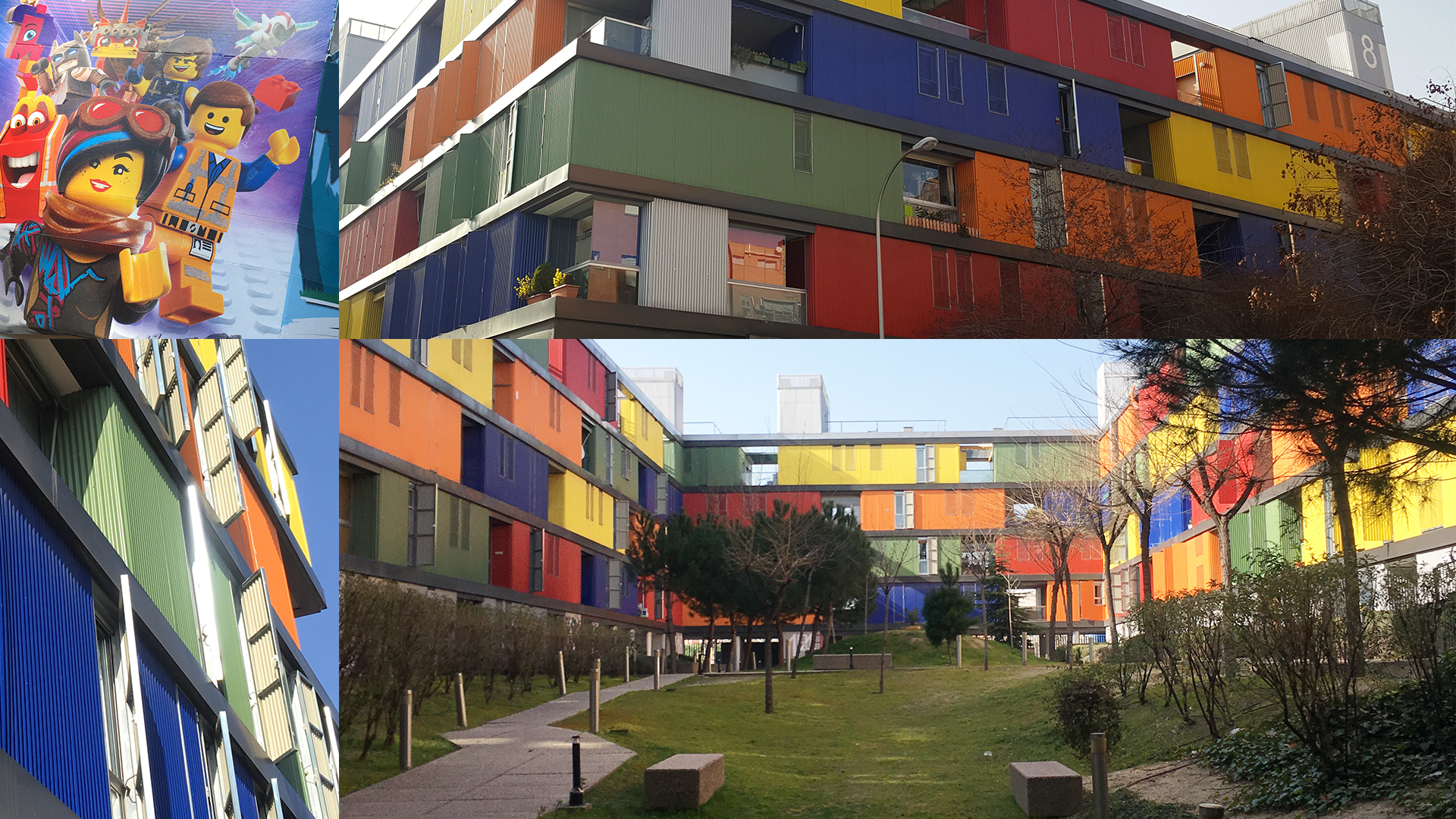
Public housing constructed of shipping containers in the neighborhood of Carabanchel. “Looks like Legos”- commented one student- shapes and voids. And right there in the trash can was a Lego themed Happy Meal. Perfect.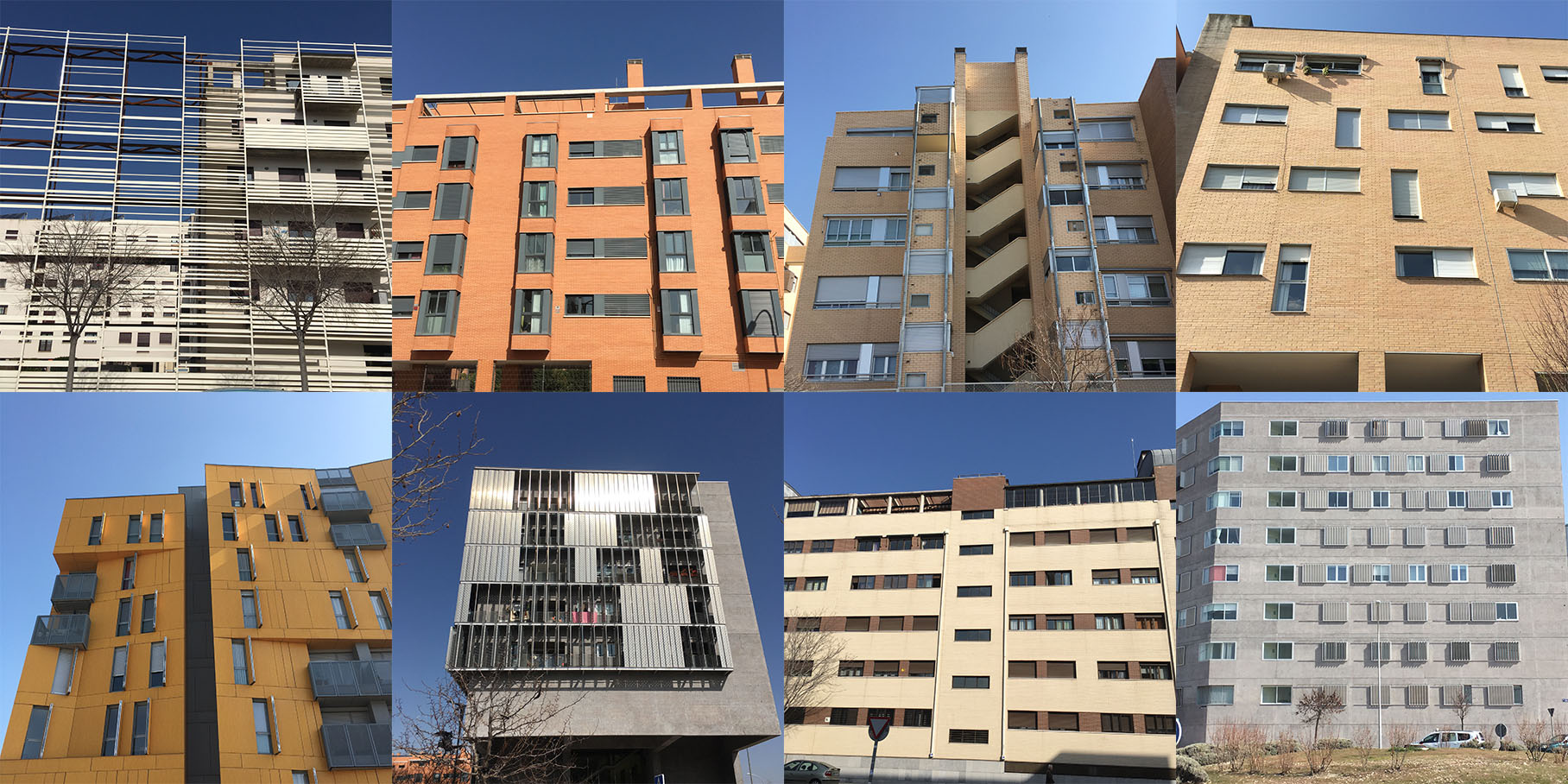
Facades of public housing in Carabanchel and Vallecas.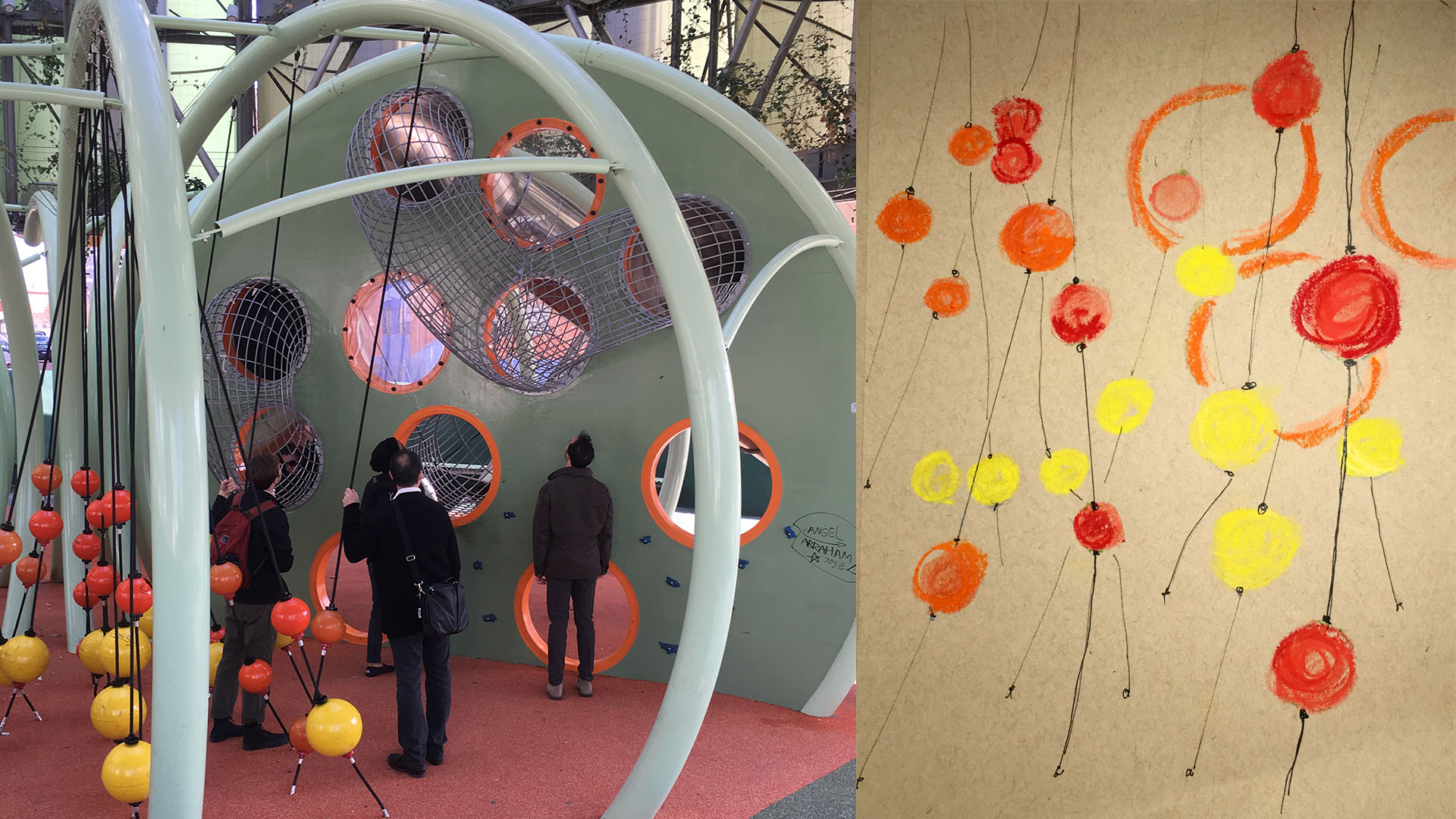
Located on the “Eco-Street” in Vallecas, a park under a giant air filter shelter. Reminded me of our challenge in studio to represent the invisible- air.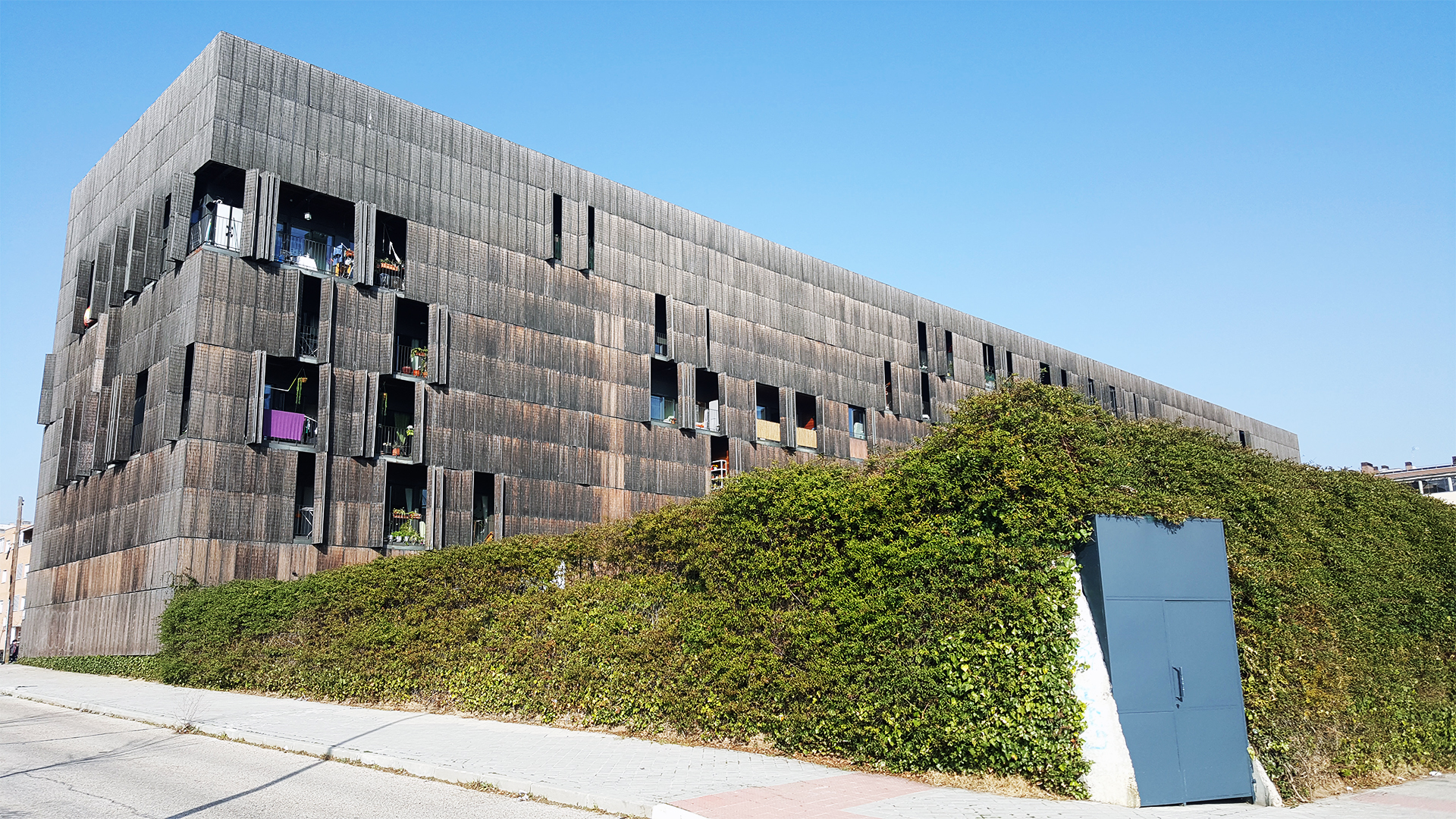
Public housing on the outskirts of Madrid in the neighborhood of Carabanchel. The use of a double facade to mediate the summers high temperatures.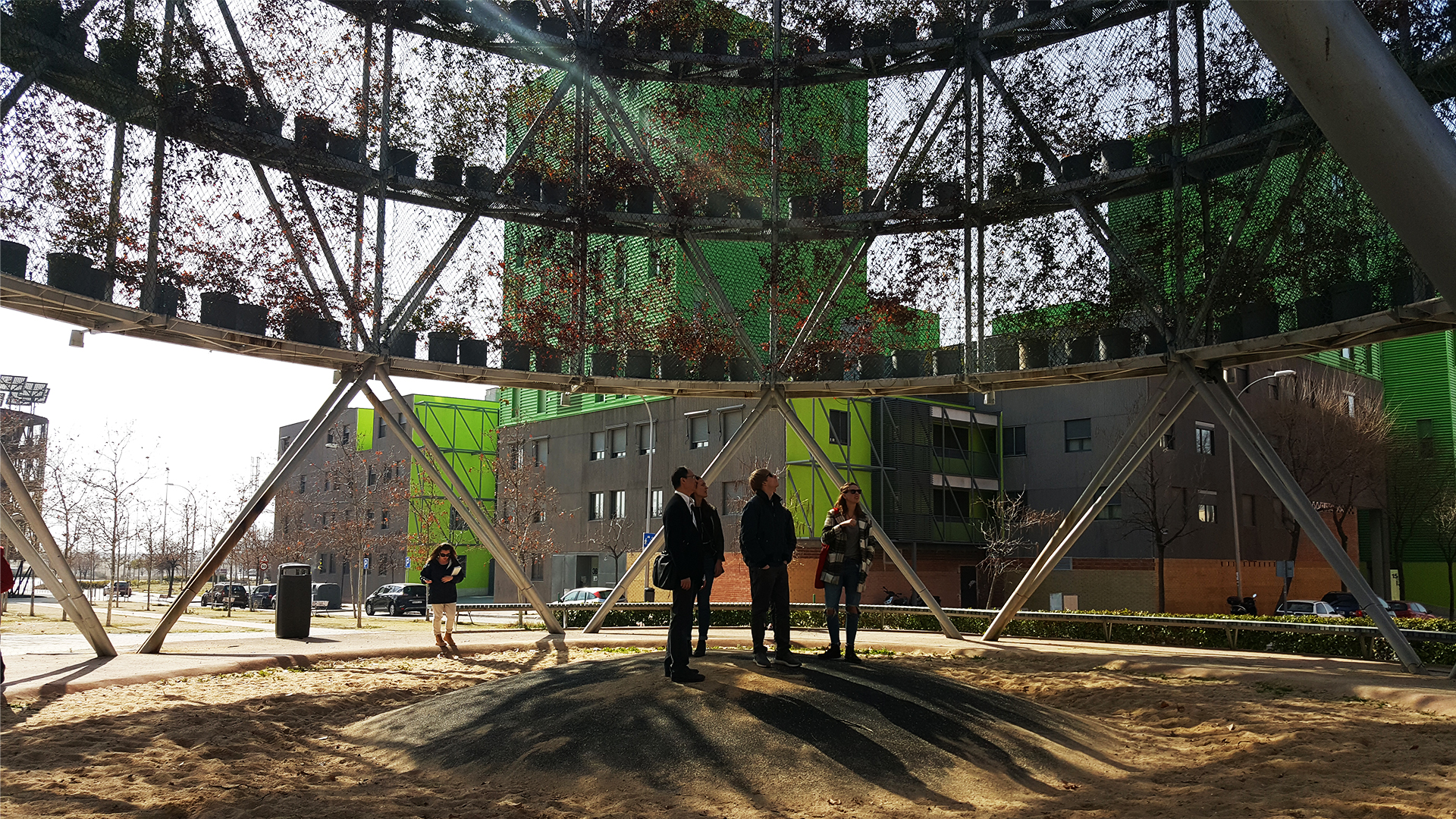
Circular structure intended to be public space that provides shade, a place for plants and air purification.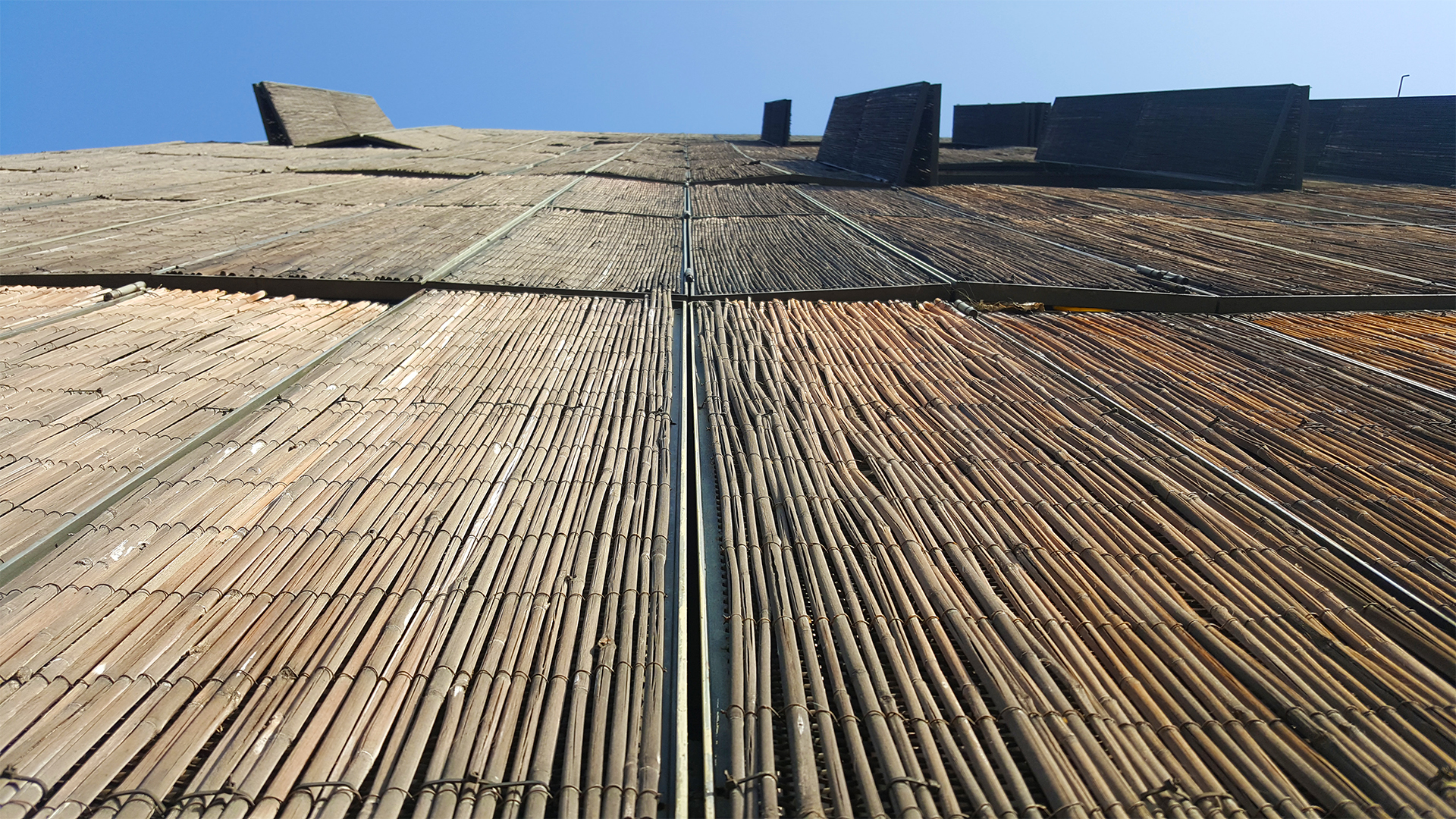
The first building we saw used a wall of banded bamboo to better insulate the building and provide texture.
We had an architect, Daniel Simínovich Glattstein, as our host for the day who approached the tour with a critical point of view and encouraged a discussion format as a form of group discovery. Our first destination of the social housing tour was the neighborhood of Carabanchel. During our drive there, Daniel began pointing out significant buildings we would pass and the contrast between the 20th century and 17th century structures with a heavy focus on an area called the Golden Mile where the time periods seem to be in high contrast. We also learned that the river that once ran through the Golden Mile area divided the current road between the rich on the left and the poor on the right. This idea of barriers in the landscape and architecture became a consistent theme through the tour and Daniel provided many examples during our stops.
The first example we saw was a social housing structure in Carabanchel called the Bamboo House built in the early 2000’s. A double facade system was used to help manage fluctuating temperatures with handmade bamboo panels, stained black from wear, giving the building a very modern and enclosed skin. These panels ran from the top of the building straight to the ground plane bringing up an issue we discussed concerning the buildings relationship to the landscape and its implications as a barrier. As we toured the buildings exterior, we learned about the complex issues that lead to the social housing in Madrid. Daniel explained that Madrid’s social housing came about when the city had money to spend thus resulting in a boom of construction in these neighborhoods. The projects came with low budgets, high corruption, many architects designing separately, and horrible urban planning. The Carabanchel neighborhood and the Bamboo House are just a small example of the results to these issues. We saw a lower density plan contributing to lower safety and numerous barriers between people, the architecture and the landscape. This breaking of the spaces has led to an inconsistent understanding of isolation and its relationship to space within all scales of the Carabanchel.
The implications for our walk around Carabanchel and Vallecas were eerie. Compared to the dense and narrow streets of Madrid, the increased space resulted in nearly empty streets. Fewer pedestrians walked around, and the boulevards were oversized for the number of cars passing by. The spacing of the built environment here was more familiar with what one might find in and around the Twin Cities, yet the distance of these former isolated villages—along with the policy and economic issues mentioned above—produced an environment devoid of reasons to walk the streets. There were several restaurants, but very few stores.
Despite this, there was evidence of new construction as we wandered around Vallecas. Equipment roared, wind kicked up loose sand, and the fresh concrete was bright. It calls to mind stories of the vast ghost cities developed in China, artifacts of policy that certainly reflect flows of capital, but not of people. Here, however, the relatively empty streets do reflect a need for affordable housing. But without the planning and investment required to bring more economic infrastructure, the social housing projects feel incomplete.
While there may be an economic reason the streets feel empty, there are plenty reasons to wander around. The result of the forces we’ve discussed has also produced a delightful patchwork of architecture, from colorful, punctured facades to monotone and imposing volumes. The contrast of architectural aspiration (as a force for good) with the reality of empty open spaces suggests that designers have more work to do–within other systems and scales–in order to realize a more equitable world.
 Cities on Water 2019